
Starting Homeschooling Can Be Simple—With the Right Guide
The idea of homeschooling can feel overwhelming at first. So many questions arise:
-
Where do I start?
-
What does my state require?
-
How will I know if I’m doing it right?
Here’s the good news: you are not alone. And with the right tools and encouragement, you can confidently begin this journey.
This comprehensive guide walks you through every step of how to start homeschooling. Whether you’re pursuing homeschooling for academic flexibility, faith-based education, or a more peaceful learning environment, you’ll find what you need here.
Let’s begin!
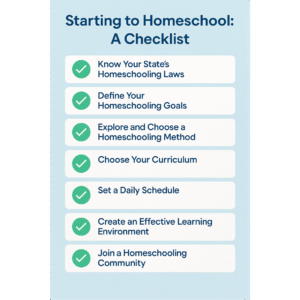
1. Know Your State’s Homeschooling Laws
Before you start printing worksheets or building a curriculum, it’s critical to understand the legal landscape.
Every U.S. state has its own homeschool laws. These might include:
-
Filing a notice of intent
-
Teaching required subjects
-
Tracking attendance or progress
-
Participating in annual assessments or evaluations
Some states—like Texas and Alaska—are very flexible. Others—like New York or Pennsylvania—require more documentation. Read our blog post on this for crystal clear clarity.
📌 Action Step: Visit hslda.org/legal to explore your state’s specific laws and requirements.
🟢 Tip: Keep a binder or digital folder to track records. This will help if you ever need to show proof of instruction or attendance.
2. Define Your Homeschooling Goals
Homeschooling is more than just academics. It’s a lifestyle shift, and your reasons matter.
Ask yourself:
-
Do I want to tailor education to my child’s learning style?
-
Is my goal to bring biblical values into daily learning?
-
Do I want a flexible schedule to include travel or mission work?
Once your goals are clear, they’ll help guide your choices—from curriculum to co-op participation.
📝 Write down your “why”. Revisit it often to stay focused, especially on the tough days.
3. Explore Different Homeschooling Methods
One of the best things about homeschooling is the freedom to choose a method that fits your child and your teaching style.
Here are a few popular options:
| Method | Description |
|---|---|
| Traditional | Mimics school structure with textbooks, tests, and schedules |
| Classical | Focuses on language, logic, and reasoning through the Trivium |
| Charlotte Mason | Uses living books, nature, and short, gentle lessons |
| Montessori | Hands-on, self-paced learning focused on life skills |
| Unschooling | Child-led learning based on curiosity and real-world experiences |
| Unit Studies | Integrates all subjects into thematic projects |
| Eclectic | Mix-and-match approach tailored to each child |
🎯 Choose a method that aligns with your child’s needs—and don’t be afraid to adjust over time.
4. Choose Your Homeschool Curriculum
Now that you have your goals and method, it’s time to select curriculum materials.
Consider:
-
Your state’s subject requirements
-
Your budget
-
Your child’s grade level and interests
-
Biblical alignment (if desired)
You can:
-
Buy a boxed curriculum (all-in-one package)
-
Use free online resources
-
Create your own using books, field trips, and online tools
-
Mix and match various providers
🌟 Bonus: Our HeroesMart Bible-based workbook curriculum is perfect for parents seeking structured academic learning with moral values.
👉 Buy on Amazon
5. Set a Realistic Daily Schedule
Every homeschool day doesn’t have to look the same—but a basic rhythm brings peace.
A sample day might look like:
| Time | Activity |
|---|---|
| 8:00 AM | Morning devotion and prayer |
| 8:30 AM | Math |
| 9:15 AM | Language arts |
| 10:00 AM | Snack + movement break |
| 10:30 AM | History or science |
| 11:30 AM | Reading or creative writing |
| 12:00 PM | Lunch and free play |
| 1:30 PM | Art, music, or nature study |
Remember to include breaks, physical activity, and family devotions.
👉 Need help planning?
Download our FREE Ultimate Character Workbook to blend academics and biblical virtues!
6. Create a Conducive Learning Environment
You don’t need a classroom or Pinterest-worthy setup—but your space should:
-
Be organized and clutter-free
-
Have basic supplies: pencils, notebooks, bookshelves, timer, etc.
-
Include cozy reading corners or exploration zones
Children thrive when they have clear structure and freedom within boundaries.
💡 Pro tip: Let your child help decorate or organize their space—it builds ownership.
7. Join a Homeschool Community
One of the best ways to gain confidence is to connect with other homeschoolers.
Look for:
-
Local co-ops and hybrid programs
-
Church-based homeschool groups
-
Online forums (like Facebook groups, The Well-Trained Mind forum)
-
Local events or homeschool days at museums and zoos
These communities offer:
-
Field trips and enrichment
-
Group classes
-
Encouragement and advice
📬 Also, join our mailing list for weekly encouragement and homeschool freebies!
👉 Sign up here
8. Begin with Patience and Grace
Your first week might feel messy. That’s okay.
There will be moments of doubt. Days where nothing goes as planned. Times you question if you’re doing enough.
But remember:
-
You are learning with your child.
-
Progress happens slowly, then suddenly.
-
Flexibility is a strength, not a flaw.
📖 Proverbs 22:6 reminds us:
“Train up a child in the way he should go, and when he is old he will not depart from it.”
Homeschooling is not about perfection—it’s about purpose.
Real-World Tips from Experienced Homeschoolers
“I started with a boxed curriculum and soon realized I needed flexibility. Now we combine Charlotte Mason and unit studies—and it’s perfect for my boys.”
— Tara M., Georgia
“Joining a local co-op saved me. I didn’t realize how much I needed community until I found it.”
— Michelle L., Texas
“We began homeschooling during a difficult season, and it brought so much peace to our home.”
— Darnell & Joyce, California
Key Resources You Can Use Today
✅ HeroesMart Academy Enrollment – Christ-Centered Structured Learning »
✅ FREE Curriculum Videos on YouTube for Pre-K to 5 »
✅ Bible-Based Curriculum Workbook (Paperback) on Amazon »
✅ Get our Ultimate Character Development Workbook (Free) »
✅ Join our Mailing List for Freebies & Encouragement »
Final Thoughts: Start Small, Stay Steady, Trust God
Homeschooling is not a sprint—it’s a journey of faith, growth, and togetherness.
You won’t have all the answers today. But with God’s help and practical support, you’ll discover what works best for your child, your rhythm, and your goals.
So take that first step—with confidence and grace.
👉 Ready to begin? Enroll now at HeroesMart Academy and explore a structured path grounded in Scripture.
🙌 – Mrs. Nita | HeroesMart Academy

Mrs. Nita is co-founder of HeroesMart Academy, co-creator of Godly Learners curriculum and lead instructor at https://www.youtube.com/@HeroesMartHomeschoolAcademy. When she’s not building homeschool content, you can find her enjoying time with her husband and four little ones.